
The best way to understand the theory of a viral loop is to study the companies that used them to reach billion-dollar valuations. The most successful apps in the world didn’t just get lucky; they meticulously engineered systems where their users became their primary, unpaid acquisition channel. These product-led growth examples are the ultimate case studies in lowering your Customer Acquisition Cost (CAC) to zero.
I am Samuel, Co-Founder and Head of Growth at Tapp. In this guide, I am going to deconstruct 10 famous viral loop examples from top apps. We won’t just describe what they are; we will analyze the psychology of why they work, and provide a clear framework for how you can replicate their core mechanics in your own app.
Table of Contents
Part 1: Incentivized Viral Loops
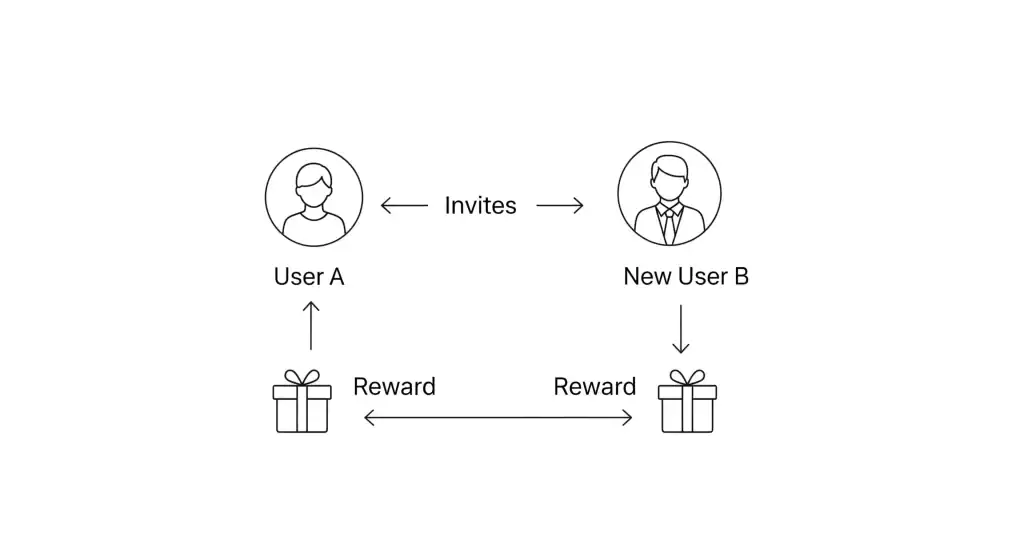
These loops operate on a clear, transactional value exchange. The user is offered a tangible reward for successfully referring a new user through a custom deep link.
1. The Dropbox Viral Loop: Incentivized Storage
The Loop: Dropbox offered users a simple proposition: invite a friend, and if they sign up, both you and your friend get 500 MB of extra storage space, for free.
Why It Works: The reward (storage space) is tied directly to the core value of the product. More storage makes Dropbox more useful, creating a powerful motivation that costs Dropbox virtually nothing to fulfill. The dual-sided nature makes the invitation feel like a genuine gift to the recipient.
2. The Robinhood Viral Loop: The Free Stock Lottery
The Loop: Robinhood offered new users and their referrers a free stock, chosen randomly, with a small chance of it being a high-value stock like Apple or Tesla.
Why It Works: This loop leverages the psychological power of variable rewards. The “lottery” aspect creates excitement and intrigue that a simple $5 cash bonus cannot match, gamifying the referral process and driving a massive K-Factor.
3. The Uber Viral Loop: Give a Ride, Get a Ride
The Loop: A user shares a promo code that gives their friend their first ride for free. Once the friend takes that ride, the original user gets a $20 credit for their next ride.
Why It Works: This removes all friction from the invitation. The sender is offering their friend something of immediate, high-utility value at no cost to themselves, bypassing the social awkwardness of “selling” a product to a friend.
Part 2: Social & User-Generated Content (UGC) Loops
These loops are completely free. They are powered by the user’s intrinsic desire to share their own creations, signaling status or creativity to their peers.
4. The TikTok Viral Loop: The Ultimate Content Engine
The Loop: The entire TikTok platform is a viral loop. A user creates a video, and the app makes it incredibly easy to share that video to Instagram or iMessage, complete with a prominent TikTok watermark and a deferred deep link back to the app.
Why It Works: It is powered by self-expression and social validation. Every shared video acts as a highly engaging, authentic advertisement for TikTok.
5. The Strava Viral Loop: The Fitness Status Symbol
The Loop: After a user completes a workout, Strava generates a visually appealing summary image with their route map and stats, perfectly formatted for sharing on social media.
Why It Works: This loop taps into pride. Athletes are proud of their accomplishments, and the shared image acts as a badge of honor for the user, and a high-quality billboard for Strava.
6. The Wordle Viral Loop: The Shareable Grid
The Loop: After completing the daily puzzle, users can share their results as a grid of green and yellow squares, showing their journey to the solution without revealing the answer.
Why It Works: It creates a sense of shared community and “FOMO” (Fear Of Missing Out). The abstract grid is instantly recognizable and creates intense curiosity among non-users.
Part 3: Collaborative Viral Loops (B2B SaaS)
These loops are built into the core utility of the product. To use the product effectively, you must invite your colleagues.
7. The Figma Viral Loop: The Multiplayer Design Tool
The Loop: To collaborate on a design file in real-time, a designer must generate a link and share it with their engineering or marketing colleagues.
Why It Works: The virality is not a feature; it is the product. The loop is driven by necessity and benefits from powerful, enterprise-wide network effects.
8. The Slack Viral Loop: Building the Workspace
The Loop: A new workspace is useless with only one member. The very first action a new user is prompted to take during onboarding is to invite their teammates via email or link.
Why It Works: Like Figma, this loop is driven by necessity. The product’s value is zero with one user and increases exponentially with each new team member added to the channel.
9. The Calendly Viral Loop: The Scheduling Handshake
The Loop: A user sets up their availability and shares their Calendly link with an external client to book a meeting.
Why It Works: Every time a user successfully uses the product, they expose a new, external user to its value. It is the perfect B2B viral vector.
10. The Notion Viral Loop: Shared Documents & Templates
The Loop: Users create and share wikis or templates with others via a public link.
Why It Works: This combines collaboration with UGC. A user shares a highly useful resource with a colleague, who then discovers the power of the Notion platform for themselves when they try to edit it.

The Common Thread: Unbreakable Infrastructure
As you can see from these viral loop examples, they all have one thing in common: they absolutely depend on perfect, deterministic attribution. Whether you need to grant a free Robinhood stock, understand which TikTok video is driving the most installs, or seamlessly route a colleague into a Figma file, you must be able to reliably connect a new user back to the specific deep link they clicked.
If that link breaks when the user is sent to the Apple App Store, the viral loop collapses.
This is the infrastructure that Tapp provides. We are the essential deferred deep linking engine behind these product-led growth examples, giving you the confidence that your data is accurate and your loop is unbreakable.
Frequently Asked Questions (FAQ)
What is the difference between a viral loop and a growth loop?
The terms are often used interchangeably. A “viral loop” specifically refers to an acquisition loop where existing users bring in new users. A “growth loop” is a broader term for any self-reinforcing system that drives growth, which could also include loops that increase retention (e.g., Push Notifications) or monetization.
Which type of viral loop is best to start with?
For most consumer apps, an incentivized loop (like a double-sided referral program) is the easiest to implement and test first. It allows you to prove the mechanics of your tracking and payout flow before building more complex, product-integrated loops like UGC features.
How do I know where to place the “share” prompt in my app?
Find the “moment of delight” in your user journey. This is the point where the user has just received maximum value from your app (e.g., after completing a level, hitting a fitness goal, or making money). This is the point of highest emotional satisfaction and the perfect time to prompt a share.
Ready to Lower Your CAC?
These successful viral loops are not accidents; they are meticulously engineered systems built on a deep understanding of user psychology and a rock-solid technical foundation.
The key takeaway is that you must start with the right infrastructure. Before you design the incentive or write the sharing copy, you must have a reliable deferred deep linking system in place to ensure the loop actually works.
Schedule a Growth Strategy Call with me today to discuss your acquisition loops.
To understand the technical code required to execute these examples, read Alex’s Engineer’s Guide to Creating Viral Loops.
Samuel Olsson is a Co-founder at Tapp and the Managing Director at Kurve, a leading mobile app marketing agency. With over 15 years of experience driving growth for top B2C brands like Canon and Sweatcoin, the #1 health and fitness app in over 119 countries, Samuel has a proven track record of scaling apps through creative, data-driven strategies. He is passionate about building the foundational technology that empowers app developers to unlock sustainable, performance-based growth.