

If you are searching for the best mobile app affiliate marketing platforms in 2026, you are likely reading listicles featuring legacy giants like Impact, MaxBounty, or PartnerStack. Let me save you a massive amount of time and margin: joining a legacy 3rd-party affiliate network is one of the most expensive mistakes a mobile growth team can make.
Most of the leading affiliate platforms today were built for a different era: web-based e-commerce. They act as expensive middle-men, charging massive fees while failing to solve the unique tracking challenges of the App Store.
The modern mobile growth playbook has changed. The “best” platform isn’t a 3rd-party network you join; it’s the first-party network you build yourself. This guide will break down why legacy platforms are failing mobile apps, and how you can use modern infrastructure to own your creators and protect your margins.
The 3rd-Party Network Tax: Why Legacy Platforms Fail Apps
Before you sign a 12-month enterprise contract with a legacy affiliate network, you need to understand the hidden costs they extract from your business.
- The Margin Tax: 3rd-party networks act as brokers. If you want to pay a creator $10 for a new subscriber, the network will charge you $13. You are surrendering 30% of your acquisition budget just for the privilege of using their platform.
- Loss of Creator Ownership: When you use a traditional network, the network owns the relationship with the affiliate, not you. You are essentially renting traffic. If you ever leave the platform, you lose your partners.
- The “App Store Black Box” Failure: Legacy platforms were built on browser cookies. When a user clicks an affiliate link and gets redirected to the Apple App Store, the cookie drops. Web-first platforms constantly lose mobile attribution data, leading to underpaid (and angry) creators.

To succeed in mobile, you don’t need a middle-man marketplace. You need a mobile-native growth infrastructure that allows you to track conversions flawlessly and pay your creators directly.
Comparing the Contenders: A Mobile-First Scorecard
Let’s evaluate the usual suspects based on the criteria that actually matter to a mobile app’s profit margins.
The Legacy Giants (e.g., Impact.com, MaxBounty)
- Core Focus: Web-First Marketplaces. These are titans in the partnership economy, built to manage massive e-commerce and B2B SaaS affiliate programs.
- The Margin Impact: High. You will pay hefty monthly SaaS fees, plus a percentage override on every payout you make to an affiliate.
- Mobile Tracking: They offer mobile tracking, but it functions as a bolted-on afterthought to their core web product. Surviving the App Store install process often requires complex, brittle integrations.
- The Verdict: Excellent if you are selling physical goods on Shopify. An expensive, clunky mismatch if you are selling subscriptions inside an iOS app.
The Web Trackers (e.g., Tapfiliate, Rewardful)
- Core Focus: Web-First Tracking. Excellent, user-friendly platforms for startups and SMBs, but fundamentally designed for websites running in a browser.
- The Margin Impact: Medium. Lower monthly fees than the giants, but they still don’t natively solve your payout logistics globally without heavy manual work.
- Mobile Tracking: Reliably tracking deep-funnel in-app events (like a paywall conversion) through the App Store black box is not their native environment.
- The Verdict: Great for web-based SaaS, but lacks the deep, native mobile deferred deep-linking required for consumer apps.
The First-Party Infrastructure (Tapp)
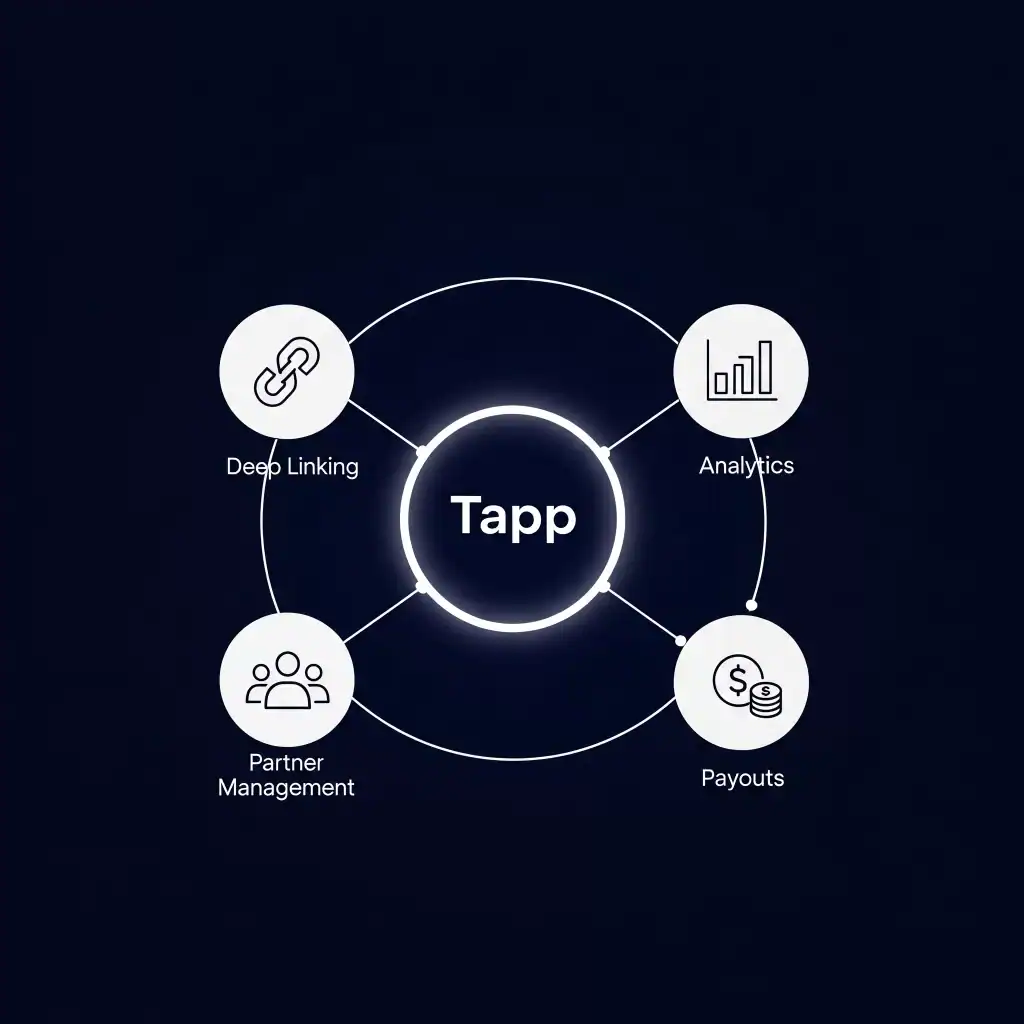
Tapp is not a 3rd-party network. We are the infrastructure that allows you to build your own. We don’t act as a middle-man. You recruit your creators, you own the first-party relationship, and you keep 100% of your margins.
- Mobile Tracking: We built the world’s most reliable deferred deep linking engine. We guarantee your tracking data survives the App Store with a 100% match rate.
- Automated Payouts: We integrated directly with Stripe. When an affiliate drives a custom event (like a “Pro” subscription), Tapp automatically routes their commission to their bank account globally. No manual spreadsheets. No network tax.
Why Building a First-Party Network Wins
Let’s summarize the key differences in a simple table.
| Criteria | Legacy 3rd-Party Networks | Web-First Trackers | Tapp (First-Party Infrastructure) |
|---|---|---|---|
| Who Owns the Creator? | The Network | You | You (100% First-Party Data) |
| Margin Impact (Tax) | High (Up to 30% network fee) | Medium (Monthly SaaS fees) | Zero Network Fees |
| Mobile App Attribution | Bolted-on afterthought | Unreliable through App Store | Core, Native Tech (Deferred Deep Linking) |
| Creator Payout Engine | Handled by network (but you pay for it) | Manual exports & PayPal | 100% Automated via Stripe |
The conclusion is clear. Trying to force a web-first marketplace to solve a mobile-native problem will inevitably lead to data discrepancies and lost margin. By treating affiliate marketing as an infrastructure play rather than a marketplace play, you secure long-term profitability.
Conclusion: Own Your Platform
For serious app affiliate programs, a mobile-native platform isn’t just a nice-to-have—it’s essential for accurately tracking conversions, building partner trust, and keeping your margins intact. Tapp is the only solution in this comparison designed from day one to combine unbreakable mobile attribution with automated global payouts.
Stop paying 30% taxes to legacy networks and stop managing influencers in spreadsheets.
Schedule a Growth Strategy Call with me today.
To understand the full strategy behind building a successful program, read my Definitive Guide to Building a First-Party Affiliate Network.

Samuel Olsson is a Co-founder at Tapp and the Managing Director at Kurve, a leading mobile app marketing agency. With over 15 years of experience driving growth for top B2C brands like Canon and Sweatcoin, the #1 health and fitness app in over 119 countries, Samuel has a proven track record of scaling apps through creative, data-driven strategies. He is passionate about building the foundational technology that empowers app developers to unlock sustainable, performance-based growth.