

Let’s be direct. The Firebase Dynamic Links deprecation has dropped a significant, unplanned project onto your roadmap. What used to be a free, reliable tool is gone, and now you’re wading through a sea of marketing jargon trying to find a replacement that doesn’t require a six-figure budget or a dedicated implementation team. You need a real Firebase Dynamic Links alternative, not a sales pitch. You need a technical breakdown, not a list of vague enterprise features.
I am the CTO of Tapp, and I have these conversations with mobile engineering teams every single day. This article is for you. I am going to cut through the noise and compare the three most discussed FDL replacements from a developer’s point of view. We’ll look at Branch, AppsFlyer, and Tapp, evaluating them on what actually matters: the underlying architecture, ease of implementation, core features, and pricing transparency.
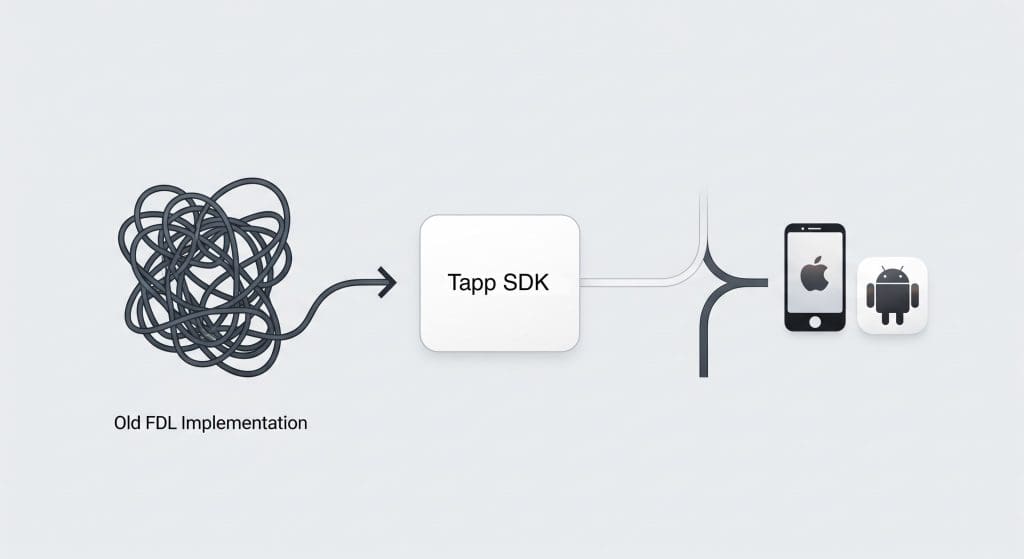
Comparing Your Top Firebase Dynamic Links Alternative Options: The Two Philosophies
Before we compare the players, it’s crucial to understand the two fundamentally different engineering philosophies at play. Your choice will depend on which philosophy best aligns with your team’s architecture.
- The Enterprise Mobile Measurement Partner (MMP): This category includes giants like Branch, AppsFlyer, Kochava, and Singular. Their primary business is enterprise-grade macro ad attribution. Deep linking is just one feature in a vast, complex, and expensive suite of tools designed for marketing departments tracking millions of dollars in ad spend across hundreds of networks.
- The Developer-First Growth Infrastructure: This is Tapp. My philosophy when building Tapp was to provide developers with a fast, plug-and-play growth infrastructure. We don’t do probabilistic fingerprinting or massive ad-network fraud prevention. Instead, we give you deterministic standalone attribution, flawless deferred deep linking, and custom webhooks to automate your referral payouts via Stripe—all without the bloat of an MMP.
Are you looking for a massive ad-attribution platform, or do you need a powerful, agile infrastructure to build custom growth loops? As we’ll see after reviewing the main guide to surviving the Firebase Dynamic Links shutdown, the answer dramatically impacts your implementation timeline and budget.
Head-to-Head Comparison: The Developer’s Guide
Let’s break down each Firebase Dynamic Links alternative based on the criteria that matter to you and your engineering team.
Branch: The Feature-Rich Behemoth
The branch vs firebase debate is common because Branch is one of the most established players. They are a true MMP, offering a massive platform for mobile growth and attribution.
Core Technology & Focus
Branch’s core focus is enterprise-level attribution. Their platform is built to help large marketing teams track ad spend across hundreds of campaigns and channels. Deep linking is a core part of this, but it’s intertwined with a much larger, more complex system of analytics and user data processing.
Implementation & SDK
This is where the developer trade-off becomes clear. The Branch SDK is notoriously heavy. It’s a powerful tool, but integrating it can be a significant undertaking. You are not just adding a deep linking tool; you are integrating an entire marketing attribution suite into your app, which can add bloat and increase complexity. The setup requires careful configuration in their extensive dashboard, and getting it right often involves a steep learning curve.
Key Features for Developers
- Robust Deferred Deep Linking: This works well, as it’s fundamental to their attribution model.
- Extensive Analytics: Provides a huge amount of data, which can be overwhelming if you only need link performance metrics.
- Journeys & Other Marketing Tools: Offers web-to-app banners and other tools, but these often come at an additional cost and add implementation complexity.
Pricing Model
Branch’s pricing is famously opaque and geared towards enterprises. You won’t find a pricing page on their website. Instead, you have to go through an enterprise sales process. It’s typically based on Monthly Active Users (MAUs) and the feature set you need, which can quickly become very expensive and unpredictable as you scale.
AppsFlyer: The Attribution Giant
AppsFlyer is another titan in the MMP space and a frequent consideration for teams looking for an appsflyer firebase integration path. Like Branch, their primary focus is on large-scale marketing attribution.
Core Technology & Focus
AppsFlyer is an analytics and attribution platform first and foremost. They are a market leader in helping enterprise clients measure marketing ROI. Their deep linking solution, OneLink, is a mature and powerful component of this larger suite, but it’s designed to serve the primary goal of macro ad attribution.
Implementation & SDK
Similar to Branch, the AppsFlyer SDK is a heavyweight component. Integrating it means pulling a large, complex attribution suite into your codebase. While the documentation is extensive, the sheer number of features and configuration options in their dashboard can be daunting for a dev team that just needs to route users and track referrals.
Key Features for Developers
- Reliable Deferred Deep Linking: OneLink is a core, reliable feature.
- Deep Analytics & Fraud Protection: Offers industry-leading tools for attribution and protecting ad spend, which is overkill for many teams.
- Extensive Partner Integrations: Connects with virtually every ad network and marketing tool imaginable.
Pricing Model
AppsFlyer follows the same enterprise playbook as Branch. There is no public pricing. Costs are customized based on MAUs, feature tiers, and support levels, negotiated through a sales process. This model is built for large, predictable enterprise budgets, not for agile teams that value transparency.
The MMP Co-Existence Strategy: What if your marketing team already signed a 12-month contract with AppsFlyer or Adjust, but you hate their deep linking implementation? You don’t have to rip them out. Modern infrastructures like Tapp are designed to sit seamlessly on top of legacy MMPs. You can let AppsFlyer handle the macro ad-attribution, while initializing the lightweight Tapp SDK to handle your custom referral webhooks and deferred deep routing without disrupting your data stack.
Tapp: The Developer-First Specialist
I built Tapp from the ground up to be the ideal Firebase Dynamic Links alternative for developers who value speed, clean APIs, and raw data payloads.
Core Technology & Focus
We provide mobile growth infrastructure. We replace the exact functionality of FDL, but we upgrade your stack by giving you standalone deterministic attribution, programmatic webhook payloads for custom events, and an automated Stripe payout engine for your creators so you don’t have to build complex wallet logic.
Implementation & SDK
This is where Tapp shines. The goal is to get you up and running in minutes, not weeks. The process is straightforward: drop in the SDK (Native, React Native, or Flutter), initialize it with your API key, and you’re ready to pass custom metadata through the App Store. It’s a clean, focused implementation without the baggage of an attribution suite.
Key Features for Developers
- Instant & Reliable Deferred Deep Linking: The core routing is rock-solid, surviving mandatory onboarding flows with a 100% match rate.
- Developer-Friendly API & Webhooks: JSON webhook payloads delivered directly to your backend, making it easy to build custom multi-tier referral programs.
- Automated CPA Engine: Tapp handles global influencer payouts via Stripe automatically.
Pricing Model
Transparent, staging-first pricing. We don’t gatekeep our API. You can grab a free staging account today to test the SDK and fire your first webhook before ever talking to our team. There are no opaque sales calls required and no hidden fees.
Comparison at a Glance
| Criteria | Branch | AppsFlyer | Tapp (Winner) |
|---|---|---|---|
| Best For | Enterprise Marketing Teams | Enterprise Ad Teams | Developers & Growth Hackers |
| Core Focus | Macro Ad Attribution | Macro Ad Attribution | Deep Links, Webhooks & Automated Payouts |
| Implementation | Complex, Heavy SDK | Complex, Heavy SDK | Simple, Lightweight SDK |
| Pricing Model | Opaque, Sales-Led | Opaque, Sales-Led | Transparent & PLG-Driven |
What About Kochava and Singular?
When researching FDL replacements, you might also encounter the kochava vs firebase or singular vs firebase comparisons. Kochava and Singular belong in the exact same category as Branch and AppsFlyer. They are powerful, enterprise-focused Mobile Measurement Partners. They offer robust deep linking as part of a much larger, more expensive attribution suite and follow the same opaque, sales-led pricing model. For developers seeking a lightweight API, they present the same challenges of complexity and bloat.
Conclusion: The Clear Choice for Developers
The FDL shutdown has forced a decision upon you, but it doesn’t have to be a painful one. While enterprise MMPs like Branch and AppsFlyer are powerful platforms, they are built to solve a different problem—massive macro ad attribution. For the vast majority of developers, founders, and growth teams who need a fast, reliable, and affordable Firebase Dynamic Links alternative to power custom referral loops, they are overkill.
I built Tapp for developers who value clean APIs, a lightweight SDK, and programmatic data payloads. It delivers the critical functionality you lost with FDL, but upgrades your stack with automated Stripe payouts and custom event webhooks.
Stop wading through sales pitches and get back to building. Get hands-on with my Technical Guide: How to Replace Firebase Dynamic Links with Tapp.
Ready to test the infrastructure? Create a Free Staging Account & Test the API today.

Alexandros Stergiou is the CTO and Co-Founder of Tapp. As a patented mobile software engineer and inventor, Alexandros specializes in cross-platform SDK architecture (React Native, Flutter) and native iOS/Android development. He built Tapp to provide developers with a lightweight, reliable mobile growth infrastructure without the enterprise bloat.