
You’ve convinced a top-tier YouTube creator to ditch their $10,000 flat fee and join your performance-based CPA program. They make a great video, drop their link in the description, and the traffic starts flowing. But a week later, they email you: “My analytics show 10,000 clicks, but your dashboard says I only drove 5 trial signups. What gives?”
If you can’t confidently track mobile affiliate conversions, your first-party affiliate network will collapse before it even begins. Broken tracking leads to incorrect payouts, furious partners, and a complete inability to scale what should be your most profitable growth channel.
In this guide, I’m going to explain exactly why the “App Store Black Box” breaks traditional web affiliate tracking, and how modern growth infrastructure allows you to achieve flawless mobile affiliate attribution using Tapp.
| The Tapp Growth Infrastructure at a Glance | |
|---|---|
| Unique Affiliate Links | Generates unbreakable deferred deep links for every creator, allowing you to append custom metadata (like creator_id=mrbeast). |
| The 100% Match Rate | Reliably identifies which affiliate drove an app install, preserving the tracking payload even if the user goes through a mandatory App Store download first. |
| Automated Event Webhooks | Accurately ties deep-funnel conversions (like paywall purchases) back to the original affiliate source, and fires the data directly to your backend or Stripe account. |
Why Is It So Hard to Track Mobile Affiliate Conversions?
If your marketing team is used to running web-based affiliate programs (like promoting a Shopify store), mobile tracking is a rude awakening. The core issue is what we call the “App Store Black Box.”

Here is why traditional tracking links fail miserably on mobile:
- The Click: A user clicks a creator’s link in a YouTube description. If this were a website, a cookie would be placed in their browser.
- The Black Box: The user is redirected to the Apple App Store or Google Play Store. At this point, the connection to the original click is severed. The App Store intentionally strips all tracking cookies and does not pass referral data back to your app.
- The Install: The user installs and opens your app. Without specialized infrastructure, they look like a random organic install. The affiliate loses their commission.
This journey makes it impossible to reliably attribute an install—let alone a valuable CPA conversion like a “Pro” subscription—back to the correct partner using basic URLs. The solution is a deterministic architecture known as deferred deep linking. (If you want the hardcore engineering breakdown on this, read our CTO’s guide: Deep Links vs. Dynamic Links vs. Universal Links).
The Solution: Flawless Mobile Affiliate Attribution with Tapp
You don’t need to build a custom attribution engine from scratch. Here is how your development team can implement an unbreakable in-app affiliate tracking system using the Tapp SDK in a matter of hours.
Step 1: Generate the Deferred Tracking Link
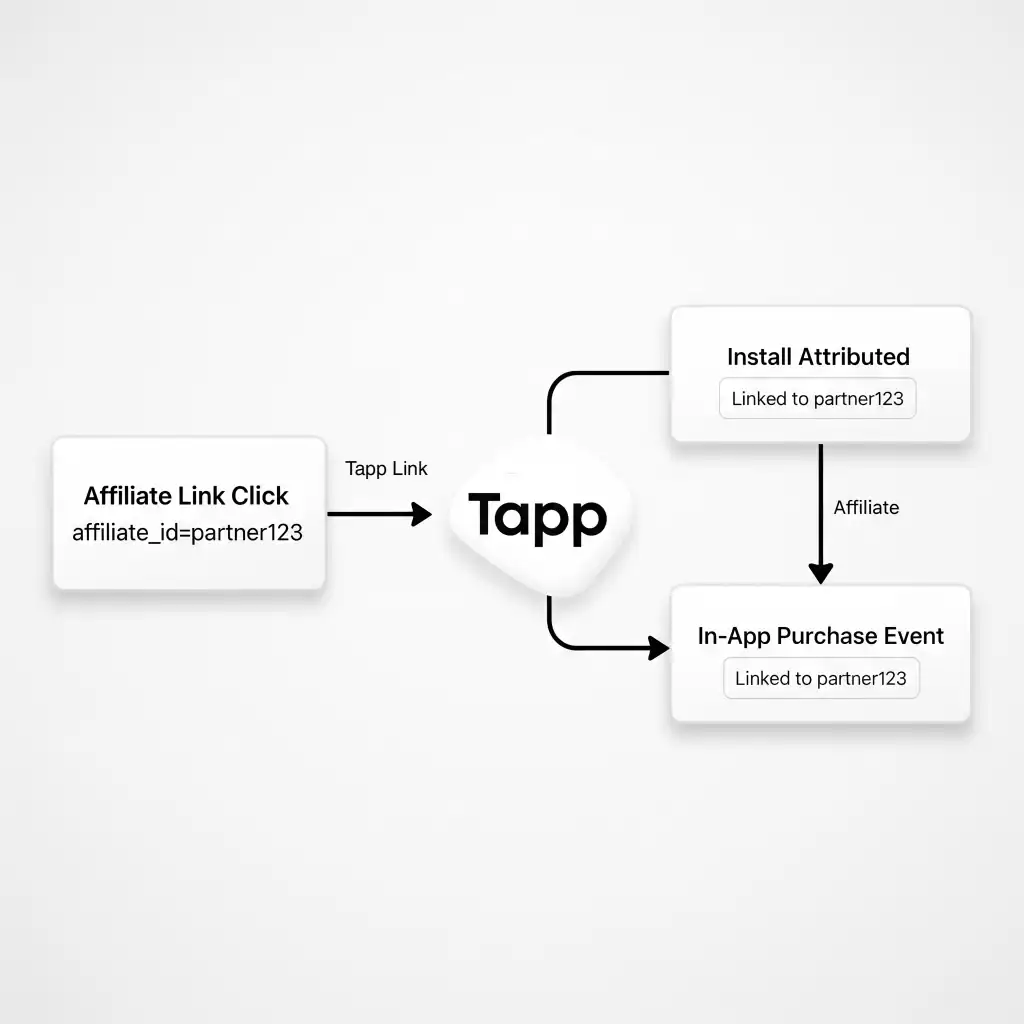
The foundation of a first-party network is the link itself. With Tapp, you generate a unique deferred deep link for every creator. Crucially, you can attach hidden JSON parameters to this link.
For example, a link for a creator named “Partner123” might look like a simple URL (tapp.so/ref) to the user, but under the hood, it contains:
{ "affiliate_id": "partner123", "campaign": "summer_promo" }
When a user clicks this link, that exact payload is securely stored by Tapp’s cloud infrastructure, waiting for the user to survive the App Store install.
Step 2: The App Startup Match
This is where the infrastructure proves its value. By implementing our lightweight SDK (available for Native iOS, Android, Flutter, and React Native), your app reaches out to Tapp upon the very first launch.
Tapp instantly matches the device to the stored payload and delivers the affiliate_id directly to your app’s codebase.
The Developer Perspective: In iOS (Swift), retrieving this data is a single line of code inside your AppDelegate: let affiliateId = deeplink.params["affiliate_id"]. Your developers can then save this ID to your own database or user defaults, ensuring the user is permanently attached to “Partner123” for future CPA payouts.
Step 3: Trigger the CPA Conversion Event
Now for the final piece: triggering the actual payout when the user completes a valuable action (like hitting a paywall and subscribing). Because your app already securely stored the affiliate_id from Step 2, tracking the conversion is simple.
When the user successfully subscribes, your app simply fires a custom event via the Tapp SDK:
Tapp.trackEvent("pro_subscription_activated")
Because Tapp’s infrastructure knows this device belongs to “Partner123”, it instantly attributes the event to them. From here, Tapp can either fire a raw JSON webhook to your backend so you can update the creator’s dashboard, or it can trigger an automated commission payout directly via our native Stripe integration.
Conclusion: Stop Losing Creators to Bad Data
Reliable in-app affiliate tracking is not a “nice-to-have”; it is the absolute foundation of a first-party CPA network. If you try to use web-first tools or ignore the App Store black box problem, you will inevitably underpay your creators. Once a creator realizes your tracking is broken, they will pull your link and never work with you again.
Tapp was built specifically to solve this core mobile attribution challenge. By implementing deterministic deferred deep linking, you can track mobile affiliate conversions with absolute confidence, ensuring every partner is compensated correctly and your margins are protected.
Stop losing conversions to unreliable tracking. Let’s discuss upgrading your infrastructure.
Schedule a Growth Strategy Call with me today.
To see how this fits into your overall strategy, read my Definitive Guide to Affiliate Marketing for Mobile Apps.

Samuel Olsson is a Co-founder at Tapp and the Managing Director at Kurve, a leading mobile app marketing agency. With over 15 years of experience driving growth for top B2C brands like Canon and Sweatcoin, the #1 health and fitness app in over 119 countries, Samuel has a proven track record of scaling apps through creative, data-driven strategies. He is passionate about building the foundational technology that empowers app developers to unlock sustainable, performance-based growth.